John Wick: Chapter 4
A 2023 American epic action thriller directed by Chad Stahelski, in which an excommunicated assassin turns a worldwide network of killers against itself in pursuit of a single duel that might buy his freedom.

At a glance
- Director
- Chad Stahelski
- Writers
- Shay Hatten, Michael Finch
- Release
- 24 March 2023 (US)
- Runtime
- 169 minutes
- Budget
- approx. $100 million
- Box office
- over $447 million
- Country
- United States
- Language
- English, Japanese, German, French
- Series
- John Wick, film 4 of 4 (so far)
Overview
John Wick: Chapter 4 is the fourth feature film in the John Wick franchise and the direct sequel to John Wick: Chapter 3 – Parabellum (2019). It was directed and co-produced by Chad Stahelski, a former stunt double who has shaped the visual and physical language of the entire series, and written by Shay Hatten and Michael Finch. Keanu Reeves returns as the legendary assassin John Wick, joined by Laurence Fishburne, Lance Reddick and Ian McShane reprising earlier roles, alongside Donnie Yen, Bill Skarsgård, Hiroyuki Sanada, Shamier Anderson, Rina Sawayama, Scott Adkins and Clancy Brown in new parts.
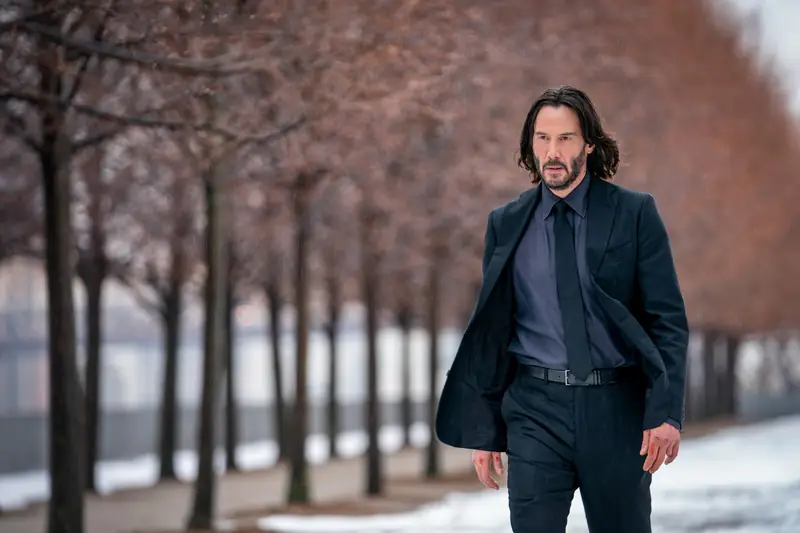
The story follows Wick after he has been declared excommunicado — outside the protection and rules of the underground assassin world governed by the High Table. Having killed "the one who sits above the Table" in Morocco, he now faces an adversary given effectively unlimited resources: the Marquis Vincent Bisset de Gramont. The Marquis dismantles Wick's remaining support network, destroys the New York Continental and executes its concierge, Charon. Wick's response is not simply to run or to kill his way out, but to invoke an ancient custom of the Table: the right to challenge a member to a duel, with freedom as the prize.
What distinguishes Chapter 4 within the franchise is scale. Where the earlier films were built around intimate, claustrophobic fight spaces, this instalment stages its set pieces across Osaka, Berlin and Paris, using chapter-like locations and distinctive colour palettes. It is also the longest film in the series at 169 minutes and, at more than 447 million dollars worldwide, its most commercially successful. Critics praised the choreography, cinematography, production design and the performances of Reeves and Yen, and the film is widely regarded as one of the most accomplished action films of the 2020s.
"The film received critical acclaim for its action sequences, Stahelski's direction, cinematography, choreography, visual style, writing, score and performances." — Encyclopedia summary, Wikipedia
The High Table and the rules of the underworld
To understand Chapter 4, it helps to understand the constitution of the world it inhabits. The John Wick films are set in a hidden network of assassins, traffickers and informants governed by the High Table, a council of twelve representatives whose authority is absolute within that world. Transactions are made in gold coins minted by the Table, each one effectively a unit of currency and a token of contract. A coin buys a service; refusing a contract is not simply rude but a breach of the order on which the entire system rests.
At the centre of that network stand the Continentals — hotels that function as neutral ground. Inside their walls, business is conducted, contracts are negotiated, and violence is forbidden. The New York Continental, managed by Winston Scott and staffed by Charon, is the best-known example. The Osaka Continental, run by Shimazu Koji, demonstrates that the model is international. The "deconsecration" of a Continental is therefore an act of enormous symbolic violence: the Table is not just destroying a building but revoking a guarantee that characters have relied on for three films.
Below the Table sit the crime families, including the Ruska Roma, the syndicate into which Wick was born and from which he was effectively exiled. Above the ordinary representatives sit figures such as the Harbinger, who interprets procedure, and the Elder, described as "the one who sits above the Table". When Wick kills the Elder in Morocco at the start of Chapter 4, he is not killing a boss so much as striking at the idea that any person can stand outside the system. The Marquis de Gramont is the Table's answer: a functionary granted unlimited resources precisely because the matter is no longer about territory or contracts but about the legitimacy of the order itself.
The most important rule for this film is the right of challenge. A member of the underworld may demand a duel with a High Table representative, but the request must be sponsored by a crime family, and the terms — weapons, location, time and seconds — must be accepted by both sides. Winning such a duel frees the victor from all obligations to the Table. This procedure gives Chapter 4 its spine. Wick cannot win a war against an organisation that can field unlimited assassins, but he can win a duel if he can find a sponsor, survive the journey to the appointed place and keep his nerve in the final exchange. The film's elaborate machinery exists to make that single rule feel both ancient and consequential.
The result is a narrative unusual in mainstream action cinema: nearly every character is bound by law rather than loyalty. Winston betrays Wick in Chapter 3 and then helps him here, not because his feelings changed but because the rules changed. Caine fights Wick while trying to protect his daughter. Mr. Nobody hunts Wick for money and then saves him when the price stops making sense. Even the Marquis, for all his theatrical cruelty, is following a procedure — he is simply better at bending it than anyone expects until the last minute.
Detailed plot
Excommunication and the Elder
The film opens in New York City, where John Wick has been hiding underground with the Bowery King after being shot off the roof of the Continental by his friend Winston. He is recovering from injuries sustained in the events of Parabellum. His first act is a direct challenge to the authority that condemned him: he travels to Morocco and kills the Elder, the mysterious figure described as "the one who sits above the Table". The assassination is less an act of revenge than a declaration of war. It forces the High Table to respond with someone willing to treat the problem as a matter of total resource allocation rather than ritual punishment.
That someone is the Marquis Vincent Bisset de Gramont, an imperious and meticulous Table member played by Bill Skarsgård. The Marquis arrives in New York with an entourage and a set of punishments designed to demonstrate that no sanctuary is real. He summons Winston and Charon, rebukes Winston for his past failure to eliminate Wick, strips him of his managerial standing, declares him excommunicado, orders the destruction of the New York Continental and has Charon executed on the spot. The demolition of the hotel is one of the film's most striking images: a place that three previous films established as neutral ground is literally folded apart under the Table's authority.
Caine is forced out of retirement
The Marquis then turns to Caine, an old friend of Wick and a retired High Table assassin who is blind. Caine lives a quiet life with his daughter Mia, a violinist, and has no wish to return to violence. The Marquis compels him by threatening Mia's life, a piece of coercion that supplies the emotional counterweight to the film's spectacle. Caine's blindness is not treated as a gimmick. His fighting style depends on hearing, memory and an almost supernatural spatial awareness, and his duel with Wick in Osaka is staged as a contest between two men who know each other's techniques intimately.
The Marquis also recruits Chidi, his second-in-command, and deploys waves of armoured High Table personnel. Wick's old ally Winston, now stripped of status, begins to think in terms of the Table's own customs rather than conventional revenge.
The Osaka Continental
Wick seeks refuge at the Osaka Continental, managed by his friend Shimazu Koji. The hotel is presented as a quieter, more formal analogue of its New York counterpart, with Koji's daughter Akira serving as concierge. Caine, Chidi and a contingent of enforcers arrive to investigate, and the "deconsecration" of the hotel triggers a large-scale melee. Akira evacuates the guests and staff before the fighting begins, and the sequence moves from the lobby through corridors and into an open courtyard, mixing gunfire, blades and improvised weapons.
Wick and Caine finally confront one another, but their duel is interrupted by Mr. Nobody, a bounty hunter also known as the Tracker, who decides the price on Wick's head is not yet high enough to justify the trouble. Wick escapes. Koji, wounded but unwilling to let his old friend face Caine alone, attacks the blinded assassin and is killed by him; Caine deliberately spares Akira. The Osaka chapter ends with Wick stripped of another sanctuary and with Caine's loyalty fractured rather than resolved.
Winston's plan and the Ruska Roma
Back in New York, Wick meets Winston at Charon's gravesite. Winston proposes a legal route through the Table's own traditions: a challenger may demand a duel with a High Table member, and victory would sever Wick's obligations. The complication is procedural. A duel can only be requested on behalf of a crime family, so Wick must first regain membership in one. He turns to the Ruska Roma, the syndicate that raised him, and travels to its Berlin headquarters.
His adoptive sister Katia agrees to sponsor him on one condition: he must kill Killa Harkan, a High Table member who was paid by the Marquis to murder her father. Wick is escorted to Harkan's nightclub by Klaus, and after a tense game of poker, Harkan springs an ambush. With assistance from Caine and the ever-present Mr. Nobody, Wick kills Harkan and is readmitted to the Ruska Roma. Winston formally conveys the challenge to the Marquis and agrees to act as Wick's second, staking his own life and future on the outcome: if Wick wins, Winston is reinstated as manager of a rebuilt New York Continental; if Wick loses, Winston dies with him.
Paris: the duel at Sacré-Cœur
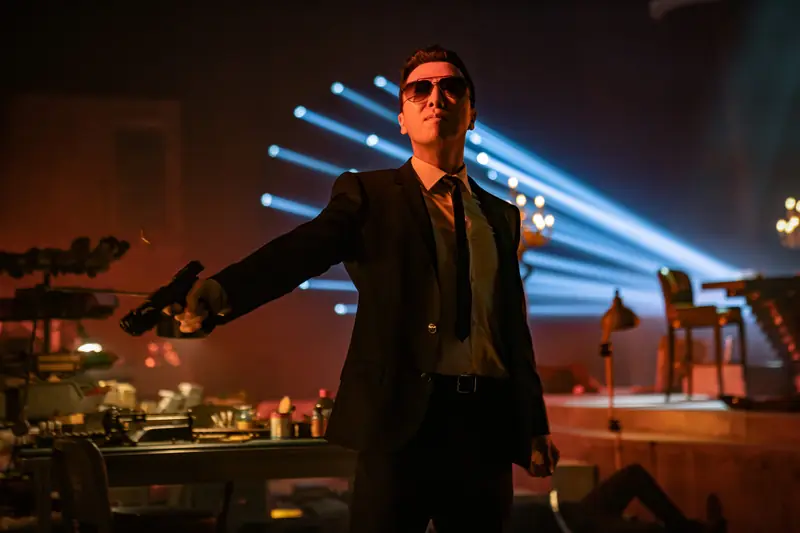
In Paris, Wick and the Marquis settle the terms of the duel under the moderation of the Harbinger, a senior Table functionary. The weapons are pistols, the place is Sacré-Cœur, and the hour is sunrise. The Marquis exploits a loophole: he names Caine as his proxy, forcing Wick to fight the one man he would rather not kill. The Harbinger warns that lateness by either Wick or Winston will result in both being executed.
The Bowery King arrives in Paris with a gift — a pistol and a ballistic suit — and the Marquis places a 25 million dollar bounty on Wick to delay him. What follows is a sustained chase through Parisian streets and the Rue Foyatier staircase, with assassins arriving in numbers that escalate almost comically. Mr. Nobody secretly assists, forcing the Marquis to raise the bounty to 40 million dollars so that he can claim it himself, then abandoning the hunt when Wick saves his dog from Chidi. Caine, Mr. Nobody and the dog help Wick cut a path up the steps to the summit, arriving just as the sun clears the skyline.
The duel itself is a masterclass in tension. Wick and Caine exchange shots across two rounds, each wounding the other. In the third round Caine lands a serious hit. The Marquis, unable to contain his impatience, insists on administering the coup de grâce himself and swaps places with Caine. Winston quietly points out the arrogance of the move: Wick never fired his third bullet. Wick executes the Marquis with a single headshot, and the Harbinger declares both Wick and Caine — along with Caine's daughter — free of the Table. Winston is reinstated.
Wick, however, is mortally wounded. He reflects on his life and his marriage to Helen, then collapses. In a final scene, Winston and the Bowery King stand beside a gravestone bearing Wick's name, next to Helen's. After the credits, Caine returns to Paris to reunite with his daughter, only to be approached by a knife-wielding Akira — a deliberate opening for future stories.
The action set pieces, explained
Chapter 4 is structured like a series of linked action vignettes, each built around a different environment and a different physical idea. Understanding the design makes the film easier to appreciate, because the fights are not random displays of weapon proficiency but responses to specific spaces.
The Osaka Continental
The first large battle takes place after the hotel is deconsecrated. Wick moves through the building with a shotgun and then a sword, fighting armoured enforcers who arrive in waves. The choreography uses the architecture: staircases, railings, sliding doors and a courtyard become obstacles and opportunities. The confrontation with Caine is deliberately quieter. Blades replace gunfire, and the two men circle each other in a space where sound matters more than sight. When Koji intervenes and is killed, the sequence shifts from spectacle to character, and Wick escapes with another safe house destroyed.
The Berlin nightclub
The Killa Harkan sequence begins as a poker game — a rare moment of stillness — before erupting into a fight that uses strobe lighting, a crowded dance floor and a rehearsed ambush. Scott Adkins, a martial artist and action performer in his own right, gives Harkan a heavy, direct style that contrasts with Wick's economical precision. The presence of Caine and Mr. Nobody in the same space turns the scene into a three-way negotiation conducted through violence, and Wick's victory restores the family status he needs to request the duel.
The Paris chase and Rue Foyatier
After the Marquis posts a 25 million dollar bounty, Paris becomes a hunting ground. Wick moves through intersections, tunnels and streets while assassins arrive from every direction. The sequence escalates again when Mr. Nobody manipulates the bounty upward, and it culminates on the Rue Foyatier, the long staircase that climbs toward Sacré-Cœur. Fighting uphill adds gravity to every exchange: characters stumble, fall and recover, and the camera repeatedly widens to show how far Wick still has to go. The arrival at the top is timed to the sunrise, tying the physical climb to the duel's legal deadline.
The duel at Sacré-Cœur
The final confrontation strips away everything that came before. Two men, two pistols, three shots each, and a witness who insists on procedure. The tension comes from restraint rather than volume. Caine and Wick wound each other deliberately and symmetrically, and the Marquis's intervention breaks the symmetry in the worst possible way for him. Wick's third bullet is the film's final argument: the system assumed he would empty his weapon, and he did not. One shot ends the story, and the abruptness is the point.
Across these sequences, the film's commitment to readable geography is consistent. Stahelski and cinematographer Dan Laustsen favour longer lenses and wider framing over the rapid cutting common in modern action films. The audience can see where everyone is, which makes each movement legible and each hit consequential. That choice is also a statement of confidence in the performers: Reeves, Yen, Adkins and their stunt teams are doing enough that the camera does not need to hide the work.
Cast and characters
The ensemble combines returning franchise anchors with performers new to the series. The result is a film in which almost every major antagonist has a distinct fighting discipline and a personal reason to be present.
| Actor | Character | Role in the story |
|---|---|---|
| Keanu Reeves | John Wick | The excommunicated assassin seeking freedom through a duel. |
| Donnie Yen | Caine | A blind, retired High Table assassin forced back into service. |
| Bill Skarsgård | Marquis de Gramont | The High Table member given unlimited resources to kill Wick. |
| Ian McShane | Winston Scott | Excommunicated manager of the New York Continental and Wick's second. |
| Lance Reddick | Charon | Winston's concierge, executed early in the film. |
| Laurence Fishburne | The Bowery King | Underground ally who supplies Wick in Paris. |
| Hiroyuki Sanada | Shimazu Koji | Manager of the Osaka Continental and old friend of Wick and Caine. |
| Rina Sawayama | Shimazu Akira | Koji's daughter and the Osaka concierge. |
| Shamier Anderson | Mr. Nobody | The Tracker, a bounty hunter motivated by price and his dog. |
| Marko Zaror | Chidi | The Marquis's ruthless second-in-command. |
| Scott Adkins | Killa Harkan | Head of the German Table, killed in the Berlin club. |
| Clancy Brown | The Harbinger | Senior High Table operative who moderates the duel. |
| Natalia Tena | Katia Javanavič | Wick's adoptive sister in the Ruska Roma. |
| George Georgiou | The Elder | "The one who sits above the Table", killed in Morocco. |
Lance Reddick's performance as Charon is especially poignant in retrospect: it was his final appearance in the role before his death in 2023. Rina Sawayama, primarily known as a musician, made her feature-film debut as Akira, with stunt performer Saori Izawa doubling her in the action scenes. Bridget Moynahan returns as Helen through archive footage from the original film.
Production
Development and writing
Lionsgate formally announced John Wick: Chapter 4 on 20 May 2019 through the franchise's opt-in text service, with a then-planned release date of 21 May 2021. In August 2020, CEO Jon Feltheimer said the studio was preparing scripts for the next two instalments and hoped to shoot the fourth and fifth films back to back. Stahelski had confirmed before the third film's release that a fourth was being planned, and the COVID-19 pandemic subsequently pushed the schedule back.
A significant change from earlier entries was the writing team. This is the first John Wick film not written by franchise creator Derek Kolstad. Shay Hatten was hired in May 2020, with Michael Finch joining in March 2021. The screenplay had to accomplish several things at once: close the arc of a character who had repeatedly been written as unkillable, introduce a credible new antagonist, and give enough space to supporting figures such as Caine, Winston and the Bowery King that the ending felt earned rather than arbitrary. The solution was the duel structure — a legal mechanism that converts an unwinnable war into a single, fair contest with a clear rulebook.
Casting
Keanu Reeves, Ian McShane, Lance Reddick and Laurence Fishburne all returned. The most consequential new casting was Donnie Yen as Caine. Yen's background as a martial artist and his experience choreographing his own fights made him a natural fit for a blind assassin whose movements must be precise and internally coherent. Bill Skarsgård took the role of the Marquis, playing him as a man whose cruelty is administrative rather than impulsive. Hiroyuki Sanada, Shamier Anderson, Rina Sawayama, Scott Adkins and Clancy Brown filled out a cast notable for the variety of combat styles it brought to the screen.
Filming and design
Principal photography ran from June to October 2021, taking place in France, Germany, New York City and Japan. Production designer Kevin Kebord and cinematographer Dan Laustsen built a film that changes visual register from chapter to chapter. Osaka is cool and blue-green,with rain-slick surfaces and traditional interiors; Berlin is industrial and red-lit; Paris is golden and monumental, culminating in the pale stone of Sacré-Cœur against a rising sun.
The action design continues the series' commitment to long takes and practical stunt work. Rather than hiding edits behind rapid cutting, Stahelski's team tends to hold the camera wide enough that the audience can read the geography of a fight. The Osaka Continental battle and the Rue Foyatier staircase sequence are built as escalating chains of encounters, each with its own weapon and rhythm. The film's 169-minute runtime allows these sequences to breathe in a way the shorter earlier films could not.
Music
The score was composed by Tyler Bates and Joel J. Richard, continuing their work on the franchise. The music leans heavily on low, pulsing electronics and percussion, often dropping out entirely during fight scenes so that sound design — gunshots, glass, bodies — carries the rhythm. The approach is deliberately functional: it supports the image without competing with it. The soundtrack also uses recurring motifs associated with the Continental and with Wick's memories of Helen, giving the film's final movement an emotional through-line beneath the spectacle.
Release and box office
John Wick: Chapter 4 premiered at the Odeon Luxe Leicester Square in London on 6 March 2023 and was released in the United States on 24 March 2023 by Lionsgate. Marketing leaned on the franchise's established iconography — the suit, the pencil, the neon-lit Continental — while emphasizing the new scale of the action and Donnie Yen's presence as Caine.
The film earned more than 447 million dollars worldwide against a production budget of approximately 100 million dollars. That made it the highest-grossing instalment in the series and one of the most profitable action releases of its year. Its performance demonstrated that a long, violent, adult-oriented action film could still command a large theatrical audience when the practical craft was visible on screen.
Critical reception and legacy
Critical response was strongly positive. Reviewers repeatedly singled out the choreography, Stahelski's direction and Laustsen's cinematography, while many noted that the film's length is justified by the confidence of its construction. The action has been described as operatic and geometrically precise: set pieces are not merely accumulations of kills but sequences with escalation, pauses and clear spatial logic. Reeves's physical commitment remains central, but the film also gives Yen, Sanada, Adkins and Anderson room to define their own screen identities through movement.
Some criticism focused on the runtime and on the thinness of the High Table's mythology, which remains more atmospheric than fully explained. Others found the body count exhausting. Even those reservations, however, tended to be framed as qualifications of admiration rather than rejections of the film.
The franchise has continued to expand. Ballerina, a spin-off set between the third and fourth films, was released in 2025. A fifth main instalment is in development. Although Chapter 4 was initially presented as a conclusion, its final scenes leave several threads open — Caine's reunion with his daughter, Akira's desire for revenge, and the fate of Wick himself — so the door was never entirely closed.
Themes and analysis
Rules, contracts and the price of freedom
The John Wick films are built on a simple fantasy: an underworld with rules so formal and ancient that they resemble a feudal legal system. Chapter 4 takes that premise to its logical conclusion. Wick cannot simply defeat the High Table in a fight, because the Table's power is procedural. It can declare a person excommunicated, deconsecrate a hotel, appoint a proxy and set a bounty. Wick's only path to freedom is to master the procedure and beat the Table at its own game. The duel at Sacré-Cœur is therefore not just a climax but an argument: a system that claims absolute authority can still be defeated by someone who understands its rules better than its rulers do.
Grief and the afterlife of love
Beneath the gunplay, the series has always been a grief story. Wick's original motivation was the death of his wife Helen, and Chapter 4 returns to that well at the moment of his collapse. The final image — his gravestone beside Helen's — reframes the entire trilogy of revenge as a long attempt to rejoin someone he lost. The film refuses to spell out whether Wick truly dies, but it treats his exhaustion as real. The question is not whether he can survive another fight, but whether he has anything left to survive for.
Blindness, trust and skill
Caine provides the film's most interesting thematic mirror. Like Wick, he is a legendary assassin pulled back into a life he had left. Unlike Wick, he can see nothing, and his battle with Wick in Osaka is choreographed around sound, memory and proximity. Their fight works because each man trusts the other's skill enough to anticipate it. When Caine spares Akira and later agrees to stand as the Marquis's proxy, he is not betraying Wick so much as trying to protect his daughter within a system that gives him no good choices.
Spectacle as architecture
Finally, the film is a study in how action can be designed rather than merely filmed. Each location functions as a stage with its own rules: the Osaka hotel rewards vertical and lateral movement, the Berlin club uses light and noise to disorient, the Paris staircase turns gravity into an antagonist. Stahelski's background in stunt work is visible in the way performers are framed at full length and allowed to complete movements. The result is a film that asks the audience to admire the mechanics of violence rather than only its outcome.
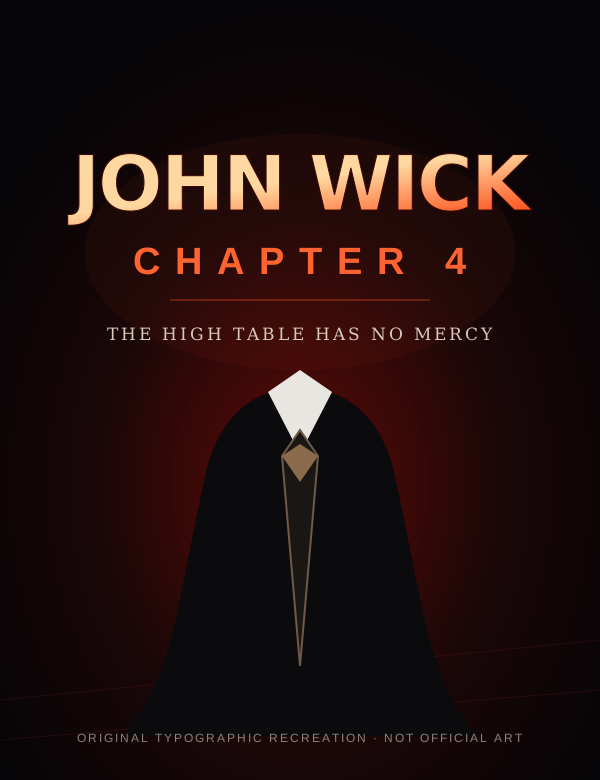
A typographic recreation of the key art
Alongside the promotional photography, this guide includes an original, text-based reinterpretation of the film's marketing imagery. It uses type, a simplified silhouette and the red neon palette associated with the series, and it is offered as commentary rather than as official artwork.
Where Chapter 4 fits in the franchise
The John Wick series began in 2014 as a relatively small revenge thriller about a retired hitman drawn back into the profession he had left. Its sequel expanded the underworld mythology, and the third film turned that mythology into a survival puzzle. Chapter 4 is the culmination of that progression: it takes every rule the earlier films established and tests whether a single person can defeat the system by using those rules better than its masters.
In narrative terms, the four films form one long arc. The first kills Wick's dog and wife and gives him a target. The second gives him a global reputation and a price on his head. The third strips him of every safe harbour. The fourth gives him a legal path to freedom, then makes him pay for it with his life. That structure explains why the ending feels conclusive even though the film leaves narrative loose ends: the emotional question that started the series — can a man who has lost everything ever be free? — is answered, and the answer is deliberately ambiguous.
The wider franchise has continued to grow. The Continental: From the World of John Wick, a prequel television series, explored the New York hotel in its earlier years. Ballerina, released in 2025 and set between Parabellum and Chapter 4, followed a different assassin inside the same world. A fifth main film is in development. Each new project reinforces what Chapter 4 demonstrated at scale: the series is less a sequence of plots than a durable set of rules, locations and visual signatures that other storytellers can work within.
For newcomers, Chapter 4 is largely accessible because it restates its own premises, but it rewards familiarity. The destruction of the New York Continental, the return of the Bowery King, the authority of the Elder and the significance of Charon all land harder if the earlier films are known. For long-time viewers, the film functions as a summa of everything the franchise had built over a decade — bigger, longer and more formally confident than its predecessors, but still centred on one exhausted man in a well-cut suit.
Recognition and year-end reception
Beyond its box office, the film appeared widely on critics' year-end lists and drew nominations across genre-focused awards, particularly for action choreography, stunt work, cinematography and sound. Its reputation has rested less on conventional awards success than on its influence within action filmmaking: the film is frequently cited in discussions of long-take choreography and practical stunt design, and its set pieces are studied for how they combine geography, lighting and rhythm. The critical consensus was that Stahelski had taken the format about as far as it could go while keeping the human stakes visible.
That reputation also rests on the performances. Reeves's commitment to performing his own stunts has become a defining feature of the series, and here he is matched by Yen, whose Caine is both a formidable fighter and a father trying to keep his child alive. Skarsgård's Marquis gives the film a villain whose menace is bureaucratic rather than animal, and McShane's Winston gets the most layered material the character has had since the original film. The ensemble acting is not flashy, but it gives the action a weight that pure spectacle would not sustain across 169 minutes.
Frequently asked questions
When was John Wick: Chapter 4 released?
It premiered in London on 6 March 2023 and opened in the United States on 24 March 2023, distributed by Lionsgate.
Who directed John Wick: Chapter 4?
Chad Stahelski directed and co-produced it. Shay Hatten and Michael Finch wrote the screenplay, making this the first film in the series not written by Derek Kolstad.
How long is the film?
Its runtime is 169 minutes — 2 hours and 49 minutes — the longest of the John Wick features.
Does John Wick die at the end?
He collapses after shooting the Marquis. A later scene shows his gravestone beside Helen's, strongly implying his death, though the film does not show the moment itself.
How much did it earn?
More than 447 million dollars worldwide on a budget of roughly 100 million dollars, the highest gross of any film in the franchise.
Is there another John Wick film?
Ballerina, a spin-off set between films three and four, arrived in 2025, and a fifth main instalment is in development.
Sources and external links
- IMDb — John Wick: Chapter 4 (tt10366206): cast, crew and release data.
- Wikipedia — John Wick: Chapter 4: plot, production and box-office summary.
- Rotten Tomatoes — John Wick: Chapter 4: critic and audience reception, promotional imagery.
- Lionsgate: distributor and official franchise announcements.
- TMDB — John Wick: Chapter 4: release and image metadata.
This page is an independent, informational fan guide. John Wick and all related marks are trademarks of their respective owners. Promotional images are used for identification and commentary.
Reader discussion
Comments appear live. Your name links to your website; links are marked
nofollow. Basic HTML is allowed in comments.Comments
No comments yet. Be the first.